

T:+91 7669-933-404
Email: info@jpinternational.co.in
Plot 3A, Sector Omega 1, Near Pari Chowk, Greater Noida, GB Nagar, Pin Code 201308

T:+91 7669-933-404
Email: info@jpinternational.co.in
Plot 3A, Sector Omega 1, Near Pari Chowk, Greater Noida, GB Nagar, Pin Code 201308
The simple act of telling stories is perhaps one of the oldest traditions. Even today, it might be one of the most effective tools that a child can use throughout the learning process, which today is fast-paced and is saturated with digital information. Whether in the rhyming narratives of folklore or the stories embedded in learning activities of a modern classroom, storytelling cultivates the imagination, as well as a variety of skills that learners may apply in their academic lives. The educational values of reading are well-known, but the specific virtues of storytelling, particularly oral storytelling, are often overlooked. These are ten amazing ways through which storytelling can improve the learning capabilities of children.
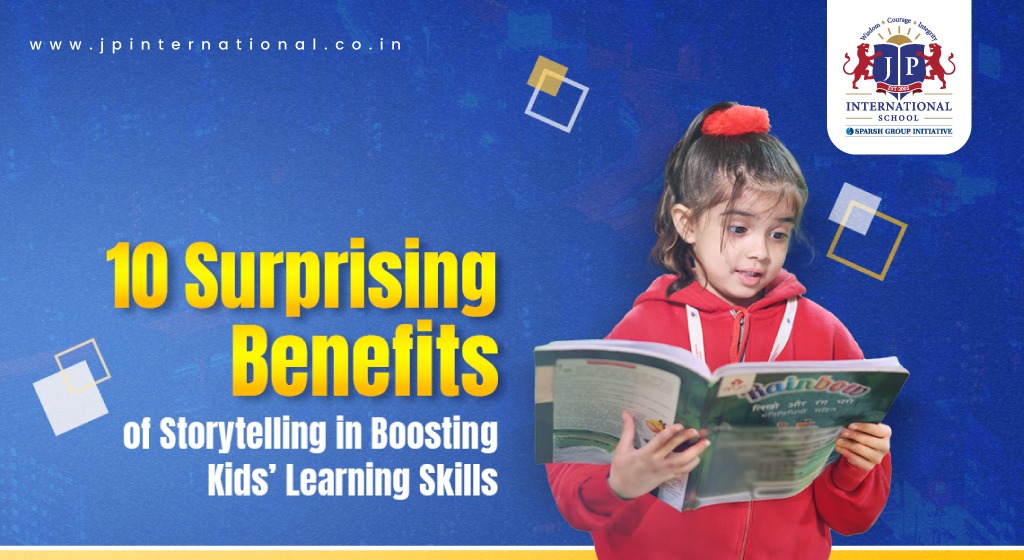
Storytelling, at its core, requires listening. In contrast to reading, storytelling does not rely on visual clues and requires children to pay full attention to the plot, characters and emotions. This develops the power of listening. It makes children more attentive and better listeners of what is said or explained to them, a skill that is essential in both real life and school examinations.
Children are exposed to a rich and broad tapestry of words, phrases and expressions through stories and it is often more than what they hear every day. Children do not consciously acquire new vocabulary or learn the use of language by context when listening to it. It's a passive learning method that aids with grammar, sentence structure and conversational skills.
The tale can take place in a dreamland, in far-away worlds, fantasy-filled forests, wherever imagination takes children. This fun activity is not merely a game but helps to think creatively and come up with mental images, which are important processes to solve a problem and be innovative in different academic fields.
Storytelling incorporates elements of repetition, patterns and sequencing. Children learn to memorise plots, personalities and even lines of the stories. The cognitive processes aid in the acquisition of memory retention and recall skills, which support education in subjects such as mathematics and science, which involve sequential thinking.
Children also get exposed to diverse cultures, feelings and dilemmas of morality through various stories. When they are applied to diverse characters, they get to know how to understand the feelings, motives and attitudes that do not quite coincide with their own. This creates empathy and emotional intelligence, which are essential in interpersonal relations and development.
A good story can capture a child's attention beyond most classroom activities. This instinctive interaction teaches children to focus on one source of information, free from distractions, thereby enhancing their concentration —a fundamental skill for effective learning.
When children are provided with the motivation to retell the stories they hear or write their own, they are taught how to present themselves verbally and convey their ideas to the audience. This improves their confidence to speak, communicate ideas and in public speaking which are all important assets in their academic life as well career.
A story takes kids into the world of traditions, beliefs and customs of different regions. It stimulates new adventurous minds and hearts to accept diversity in ways of thinking. This not only enhances their knowledge of world cultures, but also teaches them to think inclusively and respect others.
Any good story needs a conflict or a problem to be resolved. As children listen to stories, they are trained to anticipate what happens, consider the choices of characters and think through alternative options to solve problems. The psychological trigger makes them think logically and rationally.
The most unexpected advantage is that storytelling can turn the process of learning into fun. Through the inclusion of lessons in the stories, a teacher can make abstract or weighty ideas more approachable and easier to remember. The more children are taught in a presentation style that uses stories, the more they remember.
Storytelling in the learning environment is not merely an art and exercise, but an evidence-based intervention to instil a broader range of learning abilities in children. When discussing the benefits of listening with greater understanding, thinking more critically or speaking assertively with more confidence, the advantages of storytelling permeate all aspects of a child's academic and personal development.
Believing in the power of storytelling in provoking these cognitive, social and emotional processes in children, JP International School has applied storytelling in its education system. It is not merely a solution to generating an understanding of language and literature appreciation, but also a means of providing students with the life skills required to survive in today’s modern world.
While both storytelling and reading aloud offer valuable learning experiences, storytelling often involves more eye contact, body language and audience interaction. This helps children stay more engaged and develop active listening and imagination skills more effectively than when simply listening to a story being read from a book.
- JP International School16 August 2025
Educators are prepared to employ cooperative strategies in their work with all students, ensuring...
4 August 2025
Believing in the power of storytelling in provoking these cognitive, social and emotional process...
26 July 2025
The educational process of activity-based learning has been demonstrated to be an effective tool ...
19 July 2025
New-age curriculum is more comprehensive, providing students with a dynamic learning experience t...
12 July 2025
This is why ever-growing numbers of families find their way to JPIS, where their children not onl...
 28 November 2024
.jpg) 27 November 2024
27 November 2024
 8 December 2022

