

T:+91 7669-933-404
Email: info@jpinternational.co.in
Plot 3A, Sector Omega 1, Near Pari Chowk, Greater Noida, GB Nagar, Pin Code 201308

T:+91 7669-933-404
Email: info@jpinternational.co.in
Plot 3A, Sector Omega 1, Near Pari Chowk, Greater Noida, GB Nagar, Pin Code 201308
As technology is rapidly spreading its influence in every sphere of work and life, it is but natural that it has caused education to undergo a paradigm shift. Learning processes at schools have transformed at a wondrous pace with the aid of technology.
Artificial Intelligence (AI) is this amazing new-age tool of learning and is actively changing the learning experience for students. With the rising relevance of AI in schools, educators are becoming more focused on preparing students for a tech-driven future.
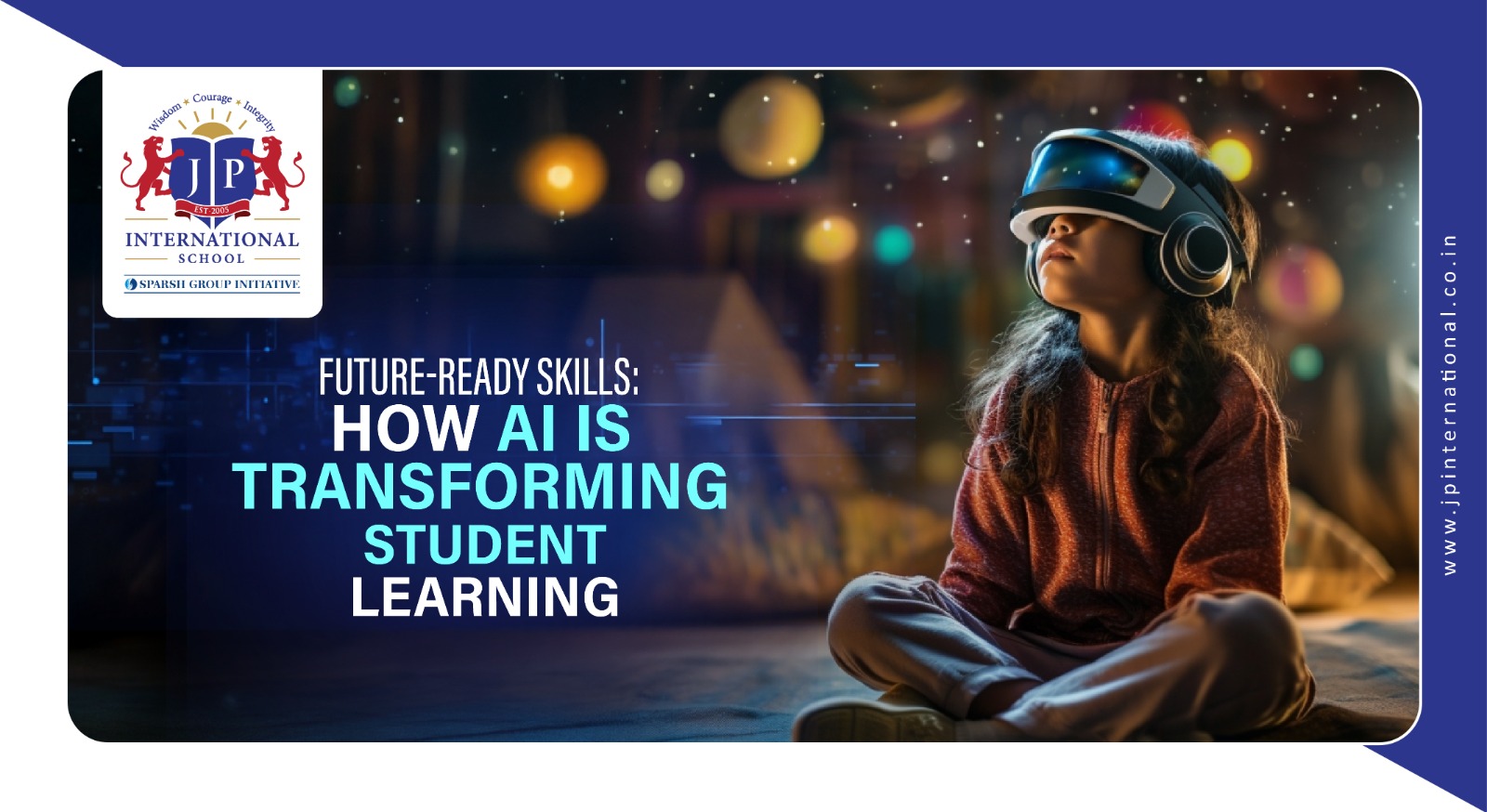
The classroom advantages of AI go deeper than being just instant answer tools. AI supports educators, boosts the process of student learning and provides a highly personal experience as per the needs of each student. For instance, intelligent tutoring systems can modify their approach to match each student’s way of learning. Through student data, the platforms identify areas of strength and areas of improvement and offer specific support to facilitate comprehension.
With virtual assistants and AI-driven chatbots being integrated into school systems, learning has become easier. These new tools make students more self-reliant in their learning and this is crucial for their future.
One of AI's most important contributions is scaling personalisation in learning. With the heterogeneous needs of students in a customary classroom, teachers usually find it challenging to address each student's needs. AI overcomes this gap by constantly tracking progress at an individual level and suggesting personalised content and interventions. AI makes learning relevant and challenging, addressing each student's strengths and areas of improvement. Moreover, AI addresses various learning styles, such as visual, auditory and kinesthetic, to ensure that each student has the best possible chance of succeeding. Such comprehensive practice can enhance academic achievements and instil confidence and a lifelong positive attitude to learning.
AI can also enhance creativity. Routine, repetitive tasks are increasingly automated, freeing students to focus on the higher-order capabilities of critical thinking, problem-solving and innovation. AI-enhanced virtual labs and simulations provide students with a risk-free environment to be inquisitive and conduct arbitrary experiments, thus enhancing learning.
In subjects like science, AI can model complex systems and phenomena to enable students to visualise abstract concepts. AI is also used in the arts to assist in music composition, digital illustration, storytelling and testing the limits of creativity.
The workforce in the future will be very different from the present. The majority of positions current students will hold in the future have not been created yet and a majority of them would have a knowledge of AI and its use. In applying AI to education, educators help learners develop technical skills, such as coding, data analytics and machine learning and soft skills like flexibility and digital literacy. Projects in schools expose students to AI analytics, simulating working conditions and training entrepreneurial minds. Such exposure Goa. long way in preparing students for industries which in particular are more impacted by AI e.g. healthcare, finance, agriculture and entertainment.
Even though much of the discussion centres on student learning, teachers are also evolving because of AI. Auto-graded assessments, attendance and administrative features free up teachers to spend more time with students and design compelling learning experiences. The other advantage of AI is that it offers helpful feedback regarding the workings of a classroom environment, enabling a teacher to identify a pattern and address it as soon as pupils are experiencing challenges.
Professional development using artificial intelligence keeps teachers updated about new pedagogies and technologies. With AI as an ally, teachers will transform into learning facilitators who help students learn how to act in a fast-changing world.
With the increased integration of AI in the educational system, there is a critical need to inculcate an ethical consciousness in students. Understanding data privacy problems, algorithmic bias and digital citizenship is necessary. Schools need to establish secure, open environments in which students are taught to be critical of technology and to use it responsibly.
By including sessions about ethics and digital responsibilities in the curriculum, students can grasp the usage aspects of AI tools and the reasoning behind their use and applications. This will create knowledgeable, responsible citizens who can live in a world dominated by intelligent machines.
The future of education is innovation within the framework of holistic development values. AI will never replace teachers, but it is a potent tool that can multiply its effects and widen learning horizons. When implemented in a considerate and ethically sound manner, AI can help schools develop future-ready students who are resilient, innovative and ready to take on a complex world.
At JP International School, inclusion of AI training comes hand-in-hand with innovation. The school realises the necessity of preparing students with skills and mindsets that will enable them to succeed in an AI-driven future. With innovative practices, state-of-the-art technology and a solid academic base, JP International School is developing learners who are prepared for the future and are adept at redefining it.
AI enhances the learning experience by offering personalised, adaptive educational content tailored to each student’s strengths and learning styles. It supports interactive tools such as virtual tutors, simulations and intelligent feedback systems that help students understand complex concepts more easily. At JP International School, AI is integrated to foster independent learning, critical thinking and creativity—skills essential for future success.
- JP International School16 August 2025
Educators are prepared to employ cooperative strategies in their work with all students, ensuring...
4 August 2025
Believing in the power of storytelling in provoking these cognitive, social and emotional process...
26 July 2025
The educational process of activity-based learning has been demonstrated to be an effective tool ...
19 July 2025
New-age curriculum is more comprehensive, providing students with a dynamic learning experience t...
12 July 2025
This is why ever-growing numbers of families find their way to JPIS, where their children not onl...
 28 November 2024
.jpg) 27 November 2024
27 November 2024
 8 December 2022

