

T:+91 7669-933-404
Email: info@jpinternational.co.in
Plot 3A, Sector Omega 1, Near Pari Chowk, Greater Noida, GB Nagar, Pin Code 201308

T:+91 7669-933-404
Email: info@jpinternational.co.in
Plot 3A, Sector Omega 1, Near Pari Chowk, Greater Noida, GB Nagar, Pin Code 201308
In today’s classrooms, collaboration is more than just group work—it's a powerful tool that shapes how students learn and connect. When learners support each other, they build not only academic skills, but also a sense of belonging and positivity. When diverse teams come together, there is a lot more exchanged than work results.
This type of learning, where students collaborate through problem-solving, assignment completion or examining ideas, has become a foundational aspect of any effective learning environment. This model not only ensures good academic results, but also contributes to emotional health, ensures a favourable school climate and paves the way for an excellent life in reality.
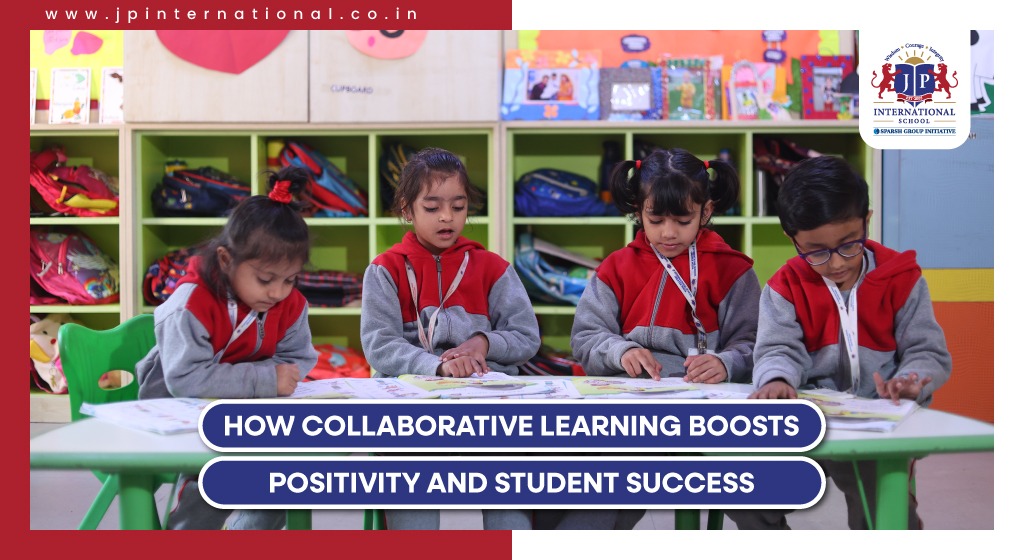
Collaborative learning is an instructional activity organised in groups, in which knowledge is shared, ideas are contested and students encourage each other in the exchange of knowledge. It is not just putting students in groups, but a specific plan to engage them and facilitate deeper learning.
The role of a teacher is to act as a facilitator to assist students in discussing matters, arguing about concepts in a respectful way and working closely to arrive at a common goal. This method nurtures conceptualisation skills in learners, which improves their knowledge and recall.
One of the most significant advantages of collaborative learning is its positive impact on student well-being. Peer work fosters a sense of community and belonging. Students become more confident, motivated and assertive when they feel valued and supported. This feeling of safety dampens fear and encourages open engagement.
Group work is also valuable for cultivating essential interpersonal skills, including empathy, patience and conflict resolution. Through this, students will know how to listen, embrace different opinions and reason out disagreements. Such experiences help build emotional maturity and better relations with peer groups.
Collaborative learning promotes engagement as students become active in their learning. Peer responsibilities can give students a greater sense of accountability, causing them to work harder. Teamwork fosters a sense of purpose through shared goals, leading to increased energy and concentration.
This method is particularly beneficial for students who are less likely to participate in classroom-wide interactions. Such students would have a greater opportunity to share their ideas, become more confident and learn to communicate effectively within smaller groups.
The fact that their voice counts motivates students more. They start taking ownership of their learning, which results in better participation and academic achievement.
A team spirit is bound to encourage a success mentality. Students learn that it is a standard practice to make mistakes in the learning process and that joint efforts can help them overcome difficult situations. Such an approach instils the concept of resilience, flexibility and a positive attitude toward failure.
Among the skills and abilities that collaborative learning environments foster are the exploration of new ideas, creative thinking and learning alongside other students. Students learn how to negotiate, compromise and strike a middle ground, which are essential life skills.
In addition to their academic performance, learning in groups not only prepares students for future work, but also equips them with the skills they develop to face the demands of universities. The current world appreciates collaboration, directed communication and problem-solving skills. Students who participate in practical group activities have the opportunity to practise skills they will need in real-world collaborative settings as adults.
Such experiences not only equip them to excel in their examinations, but also to succeed in an increasingly integrated world.
The benefits of collaboration do not end in the classroom when it is part of the school culture. It makes the learning process more enriching and respectful, where students feel empowered to present their thoughts and sincerely contribute to their own level of achievement. This promotes a positive school environment, learning and good attitude towards one another.
In JP International School, group learning has become the structural fibre of daily instruction. The school is also involved in promoting group-based learning experiences that enhance academic knowledge while maintaining emotional well-being. Educators are prepared to employ cooperative strategies in their work with all students, ensuring that everyone contributes to the learning process.
By doing so, JP International School has not only experienced an improvement in its academic performance, but has also seen a significant boost in morale, confidence and classroom conditions. The school is also focused on making learners not only innovative, but make them emotionally intelligent and ready to lead, create and innovate in the global landscape.
Yes, studies show that collaborative learning enhances comprehension, retention and problem-solving abilities. When students work together, they are more likely to internalise knowledge through discussion and mutual teaching, which positively impacts academic achievement.
- JP International School16 August 2025
Educators are prepared to employ cooperative strategies in their work with all students, ensuring...
4 August 2025
Believing in the power of storytelling in provoking these cognitive, social and emotional process...
26 July 2025
The educational process of activity-based learning has been demonstrated to be an effective tool ...
19 July 2025
New-age curriculum is more comprehensive, providing students with a dynamic learning experience t...
12 July 2025
This is why ever-growing numbers of families find their way to JPIS, where their children not onl...
 28 November 2024
.jpg) 27 November 2024
27 November 2024
 8 December 2022

