

T:+91 7669-933-404
Email: info@sparshinternational.co.in
Plot 3A, Sector Omega 1, Near Pari Chowk, Greater Noida, GB Nagar, Pin Code 201308

T:+91 7669-933-404
Email: info@sparshinternational.co.in
Plot 3A, Sector Omega 1, Near Pari Chowk, Greater Noida, GB Nagar, Pin Code 201308
In today's complex and fast-paced academics, learning and grasping difficult concepts and vast learning material might be a challenge for many. The sheer volume of information can often feel burdensome, even overwhelming, from the theories of science to the events of the past and complexities of maths. Mind mapping is, however, one of the most effective methods that can assist students in simplifying and remembering complex issues.
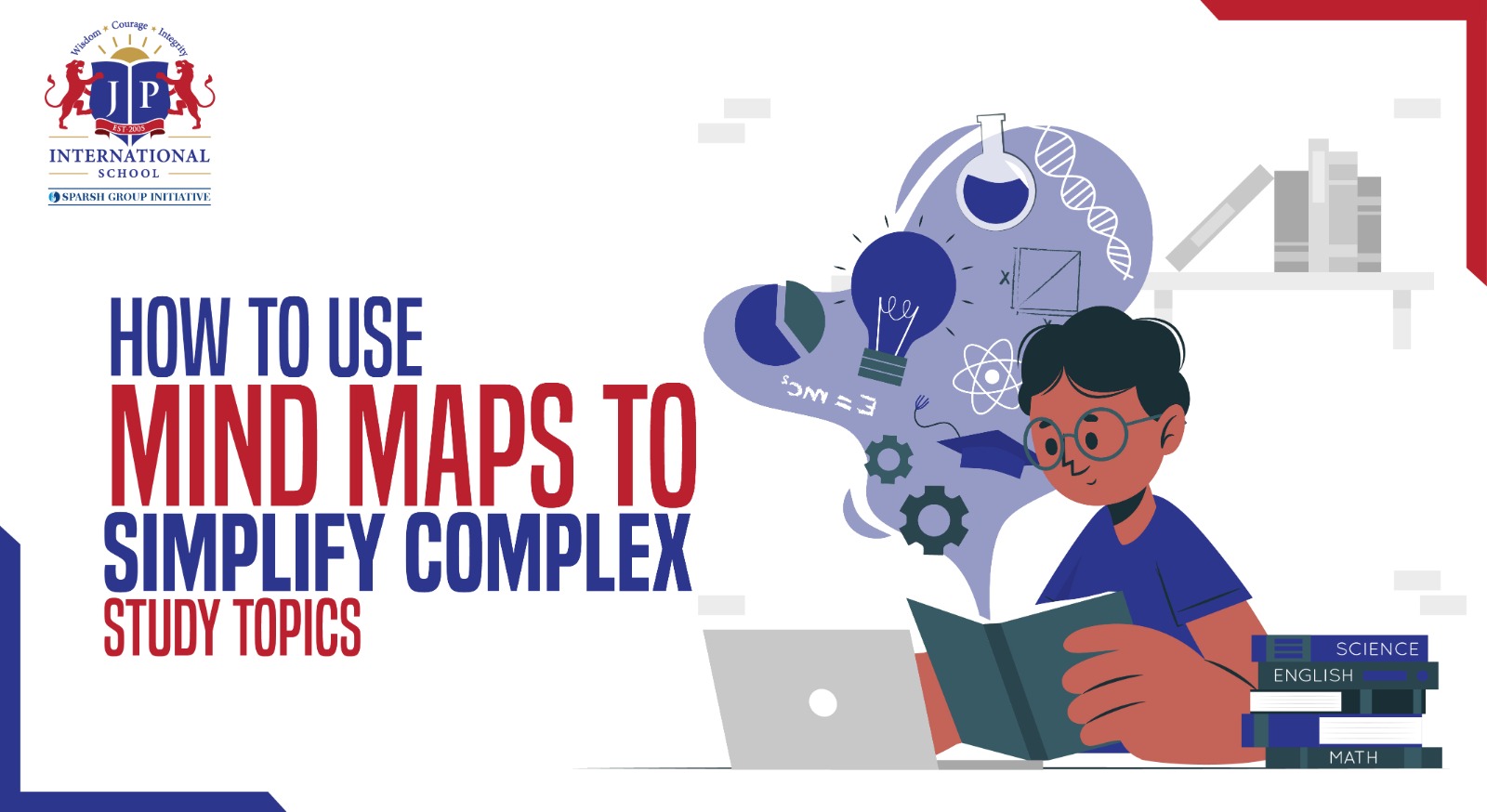
Mind maps are graphical tools that present information in an organised and easily understandable manner. They resemble the natural thinking process of the brain which involves associations and connections and this enables learning not only to be effective but also enjoyable. Mind mapping can be an effective game changer in learning, in particular for students struggling to clearly understand concepts.
A mind map is a diagram that begins with a central idea and then extends to relevant subtopics. Branches may also be subdivided into more tangible details, making a tree-like chart. It is a mind map in its simplest form, incorporating words, colours, symbols and even pictures to capture ideas in a non-sequential, creative form.
Unlike conventional note-taking, which is a top-to-bottom format, mind mapping is flexible. This style allows students to reason independently and connect various ideas, which enhances understanding and recall.
The concept of mind mapping is very close to how our brain works. The human brain is structured to think in radiant, non-linear patterns. This implies that we match ideas and information in patterns and links. A mind map helps students replicate this thought process, enabling them to grasp and recall better.
Studies have shown that mind mapping can improve memory retention by up to 15%. It promotes valuable learning, reasoning and a deeper involvement with the subject matter. Students are not just copying notes when making their mind maps; they are processing, analysing and organising their knowledge most sensibly.
Creating a mind map is a simple, yet a powerful exercise. Here’s a step-by-step guide that students can follow:
Start with a central idea: This is where the subject usually has the main topic or theme. It should be written and placed in the centre of the page. Students are also free to sketch an easy figure or colour it to make it stand out.
Add Main Branches: These are the key subtopics corresponding to the central idea. They are to be spread out, like the branches of a tree. The keywords or brief phrases must be assigned to each main branch.
Include Sub-branches: Students should add more details or related concepts under each main branch. This helps break down complex topics into manageable chunks.
Use Colours and Images: The topics can be distinguished by colour-coding various branches. Adding small sketches or icons is also essential to make the mind map more appealing and practical for memorisation.
Keep It Simple and Clear: A mind map is meant to make things easier, not complicated. Students need not use too many details on the map, but they should concentrate on important aspects only.
Mind maps can be employed at any level of learning and in any subject. In science, students can draw a mind map of the human circulatory system, where correlation exists between the heart, veins and arteries. The history of World War II may be broken down into a map, which may include causes, significant events, important individuals and results. In the case of literature, mind maps can help analyse a novel's characters, themes and plot development.
They can also be used to revise for exams. After listing the important ideas in a single visual map, students are able to gain awareness of the whole chapter at once. This will not only save time, but also enhance long-term recall.
While mind maps can be created using pen and paper, a few digital tools make the process more dynamic. Apps such as XMind, MindMeister and SimpleMind allow students to develop and edit various mind maps in colour on their devices. They are instrumental in group projects or sharing study content with classmates.
Teachers and educators can introduce and promote mind mapping to facilitate learning. When applied as part of classroom work, it encourages active student involvement and supports various learning styles (visual, auditory and kinaesthetic). Furthermore, it teaches students a skill they can apply long beyond school to real-life problem-solving, planning and creativity.
Good learning strategies are paramount in a time when students always have to convert complicated scholastic material into a structured form of visualisation that is easy to comprehend and remember. Mind maps offer a transformative yet straightforward way to break down large or complex topics into structured visual formats.
Educators at JP International School are actively embracing innovative approaches, such as mind mapping, to improve students' performance. By incorporating the tools outlined above into daily learning schedules, JP International School ensures that students do not merely learn by heart; they thoroughly acquire and apply their knowledge for a more productive outcome.
Mind maps assist students in revising more efficiently by allowing them to visualise and condense large amounts of information onto a single page. Students can see the bigger picture by breaking topics into smaller, interconnected parts while focusing on key details. This helps improve memory retention and boost confidence during revision periods.
- JP International School16 August 2025
Educators are prepared to employ cooperative strategies in their work with all students, ensuring...
4 August 2025
Believing in the power of storytelling in provoking these cognitive, social and emotional process...
26 July 2025
The educational process of activity-based learning has been demonstrated to be an effective tool ...
19 July 2025
New-age curriculum is more comprehensive, providing students with a dynamic learning experience t...
12 July 2025
This is why ever-growing numbers of families find their way to JPIS, where their children not onl...
 28 November 2024
.jpg) 27 November 2024
27 November 2024
 8 December 2022

