

T:+91 7669-933-404
Email: info@jpinternational.co.in
Plot 3A, Sector Omega 1, Near Pari Chowk, Greater Noida, GB Nagar, Pin Code 201308

T:+91 7669-933-404
Email: info@jpinternational.co.in
Plot 3A, Sector Omega 1, Near Pari Chowk, Greater Noida, GB Nagar, Pin Code 201308
The partnership of parents and teachers is one of the most vital, yet underestimated elements in an academic and personal growth of a child. Strong collaboration between school and home provides the base to holistic learning and creates an atmosphere in which students flourish. Educators and parents attain a lot many positive goals when they collaborate in a respectful atmosphere and with the common vision of creating confident, well-adjusted and successful learners in the classroom.
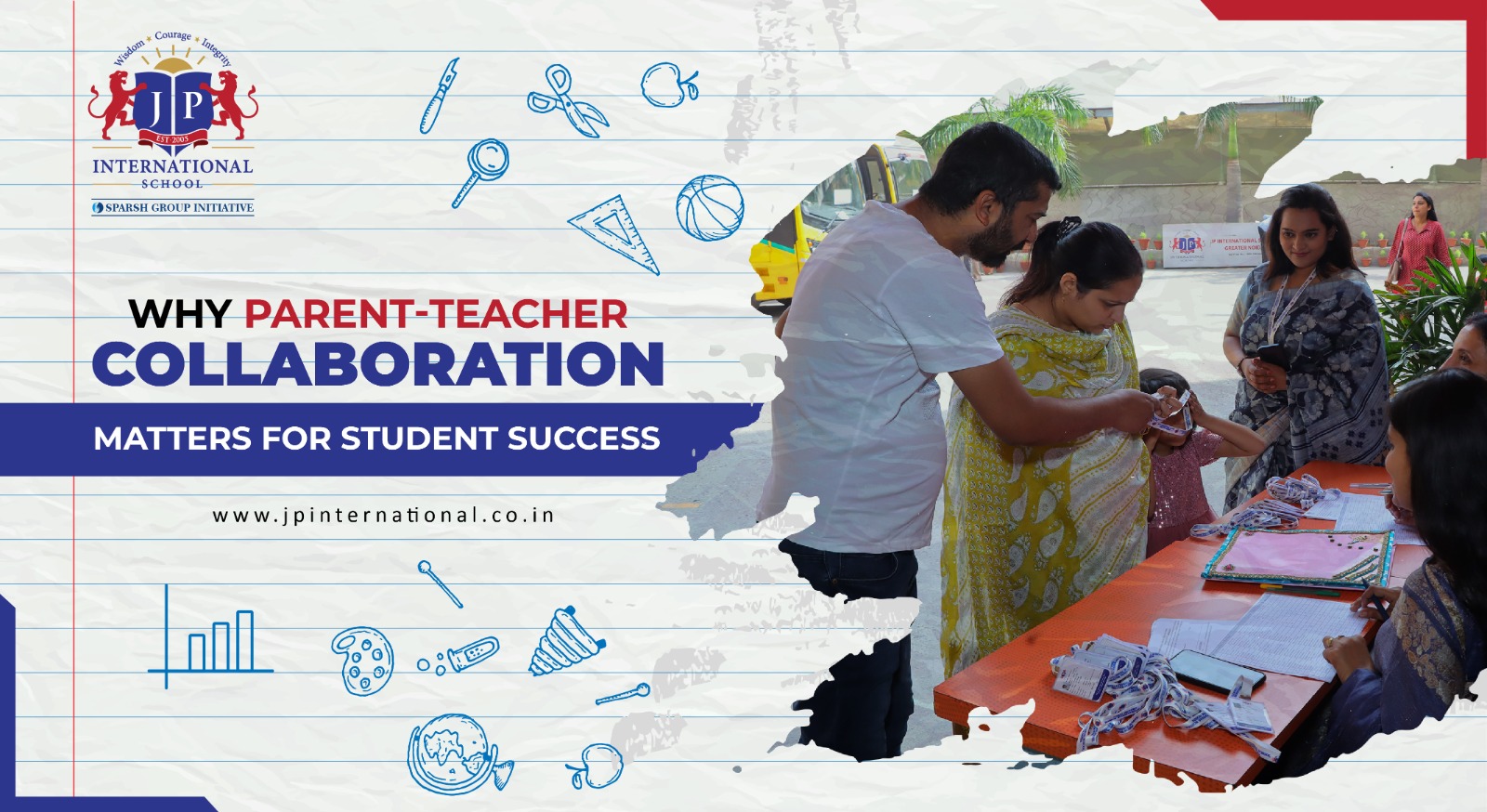
Effective education encompasses a robust support system, which begins with significant collaboration between teachers and parents. And this begins in the classroom. Here teachers observe a child throughout their course of learning, noticing their academic progress, engagement and communication. In the meantime, parents provide essential information about the child's behaviour, interests and emotional state at home. Combining the two viewpoints leads to a more realistic picture of the student's strengths, challenges and improvement areas. Parent-teacher communication should be frequent so that issues can be detected early and addressed in a timely manner, whether they are academic or behavioural.
It is important to pay attention to the fact that parental involvement is not the same as interference. While empowering children to be independent is crucial, it has been proven that active involvement of parents in their children's academics usually results in better academic results. Interaction implies providing support where needed and participating in parent-teacher meetings, school affairs and maintaining open channels of communication with teachers. A healthy parent-teacher relation results in more motivated students.
Such teamwork enables educators to customise their educational strategies more closely to the needs of individual children. In cases where a parent reports that their child learns very well with visual aids or has issues with reading comprehension, the teacher can adjust their tactics.
Education today has transcended beyond the four walls of the classroom. New-age schools engage in developing holistic individuals. This means that the only yardstick of measuring success is not exam scores and academic brilliance. Education encompasses the emotional and social development of children. When a child feels equally supported at home and at school, they become more likely to be emotionally resilient, socially confident and engaged in learning. When working with a student in terms of their emotional needs, parent-teacher cooperation plays a pivotal role in determining ways to manage anxiety, develop new friendships and gain a sense of self-esteem.
Children do well with consistency. Consistent feedback from parents and teachers on matters concerning behaviour, discipline, academics and routines makes children more focussed in their areas of development. For example, when punctuality and respect are valued at home and reinforced in school too, children tend to adopt these practices as desirable characteristics.
This harmony also eliminates the chances of mixed messages that might confuse the child. Good habits and disciplines that apply at school and home also make the child's foundation stronger and lessen the cases of rebellion or miscommunication.
An effective parent-teacher partnership fosters collaboration, leading to the development of a growth mindset among students. When children see the adult community helping to promote their learning, they start realising that learning is a process where people both succeed and experience failure. Such knowledge instils the spirit of resilience, persistence and being ready to take on challenges.
Collaboration between parents and teachers is not just about the student, but also helps build stronger organisations within the school community. When families are included in school life, the feeling of belonging and shared responsibility is developed. The involvement of parents in school activities, such as volunteering and donating to school programmes, creates a healthy and inclusive atmosphere that supports the needs of all students.
Open communication helps build trust and fosters transparency. This leads to constructive feedback and the collaborative resolution of problems. This close parent-educator relationship helps foster a culture of respect and shared responsibility, allowing students to succeed.
The role of parent-teacher cooperation on student achievement is vast and extensive. The collaboration of parents and educators forms a strong support system, which leads to the development of academic education, emotional health and future learning.
The significance of such a partnership is well understood at JP International School. The school ensures that it communicates with parents regularly, appreciating their views and this instils a sense of common mission. JP International School believes that when home and school work in collaboration, students will strive to reach their full potential and develop into confident, compassionate and competent human beings.
Parent-teacher collaboration plays a vital role in enhancing a student’s academic success. When parents and teachers communicate regularly, they can share insights about the student’s learning style, challenges and progress. This enables educators to tailor their teaching methods more effectively, while parents can support learning at home. Together, they create a consistent and supportive environment that motivates students to perform better academically.
- JP International School16 August 2025
Educators are prepared to employ cooperative strategies in their work with all students, ensuring...
4 August 2025
Believing in the power of storytelling in provoking these cognitive, social and emotional process...
26 July 2025
The educational process of activity-based learning has been demonstrated to be an effective tool ...
19 July 2025
New-age curriculum is more comprehensive, providing students with a dynamic learning experience t...
12 July 2025
This is why ever-growing numbers of families find their way to JPIS, where their children not onl...
 28 November 2024
.jpg) 27 November 2024
27 November 2024
 8 December 2022

